Unpacking Memories: A Journey to Liberation and Clarity
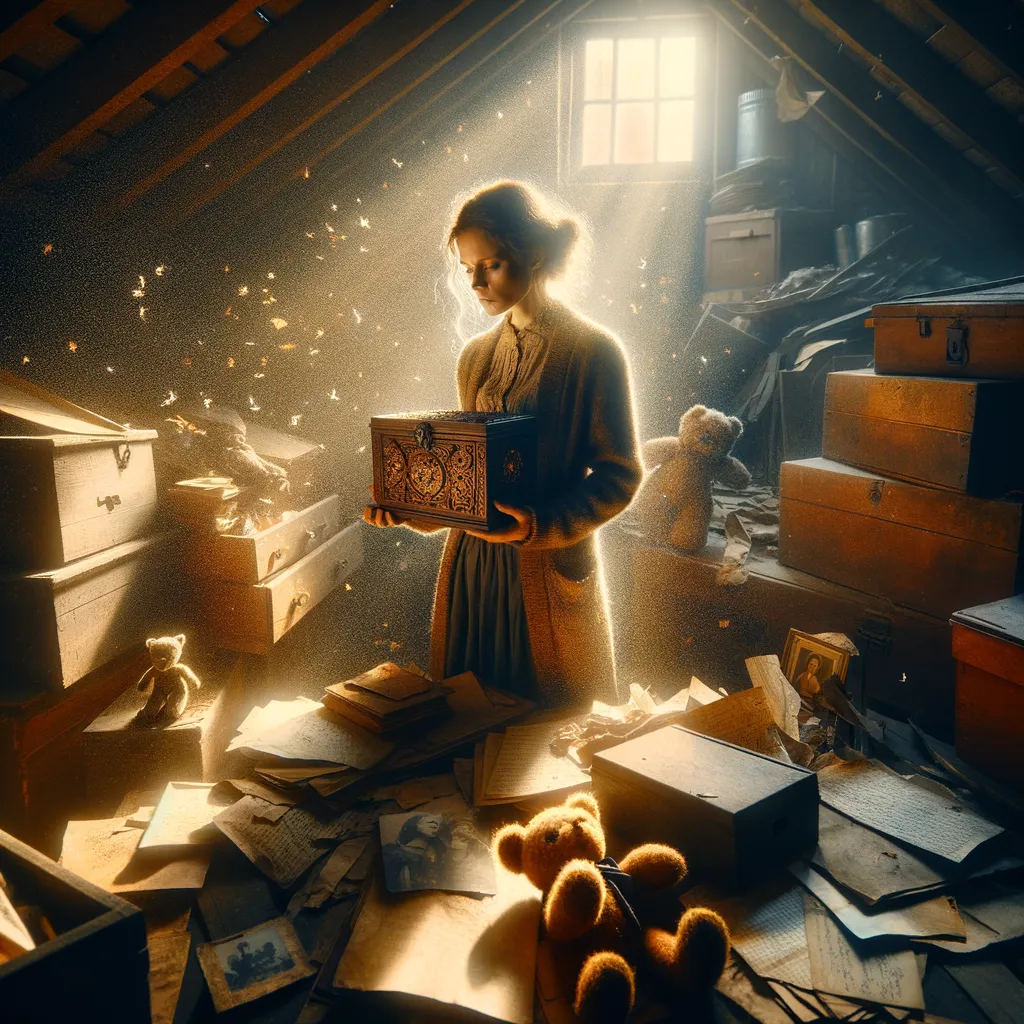
Amidst a labyrinth of dusty boxes, a solitary figure found herself sifting through the remnants of her past, each item a whisper of forgotten dreams and unfulfilled ambitions. As sunlight poured in, illuminating the particles of dust that danced like stars, she unearthed a small wooden music box, its haunting lullaby transporting her to a childhood she once cherished. Yet, in a moment of startling clarity, she recognized these cherished belongings as anchors to a life she was ready to leave behind, urging her to embrace a future unencumbered by material weight. With newfound resolve, she began to liberate herself, each discarded object a revelation that freedom lay not in possession, but in the act of letting go. As the golden light faded, she stood amidst empty spaces, realizing that true ownership was not about accumulation, but about the authentic journey of becoming, inviting her to explore a life rich in meaning rather than clutter.
In the memory of October 13, 2004, I stood amidst a sea of boxes, their cardboard edges frayed and worn from years of moving and storing. Each box held remnants of my past—forgotten dreams, half-finished projects, and trinkets that once seemed essential. The sunlight streamed through the dusty window, illuminating the motes of dust that danced like tiny stars, swirling around me as if the universe itself was conspiring to reveal a truth I had long ignored. In that moment, I felt a curious mix of nostalgia and anxiety, each object whispering stories I had long since outgrown.
As I rifled through the contents, I stumbled upon a small, wooden music box. Its surface was polished but marred by time, the intricate carvings almost hidden beneath layers of dust. I cranked the tiny key, and a delicate melody filled the room, a haunting lullaby that transported me back to simpler days. I remembered how I had once believed that this music box was a treasure, a talisman of childhood wonder. Yet, now it felt like a shackle, anchoring me to memories I was ready to release.
The realization struck me like a bolt of lightning: these possessions, once symbols of my identity, had become burdens. They were the anchors that held me in place, preventing me from sailing into the unknown waters of adulthood. The concept of ownership had twisted in my mind, morphing from a source of pride into a weighty obligation. I felt an urge to liberate myself from this entanglement, to embrace a life less cluttered, both physically and emotionally.
With newfound resolve, I began to sort through the boxes, letting go of items that no longer served me. A stack of old magazines, their pages yellowed and brittle, was the first to go. I had clung to them for years, believing they held some elusive wisdom about life and love. But as I tossed them into the growing donation pile, a surprising lightness enveloped me, as if I had shed a skin that no longer fit. Each item I released added to this sense of liberation, a gentle reminder that freedom often lies in the act of letting go.
As the day wore on, I discovered a peculiar thrill in the process. It was like unearthing buried treasure—not in the form of gold or jewels, but in the clarity of my own desires. I had been weighed down not by the items themselves, but by the memories and expectations attached to them. Each discarded piece was a step toward a more authentic version of myself, a life redefined not by accumulation but by intention. The boxes that had once seemed so heavy began to feel like portals to a brighter future.
With every object that left my possession, I felt a ripple of transformation. I realized that the relationship we have with our belongings often reflects our internal struggles. In a world that champions consumption, I found beauty in simplicity. The empty spaces in my home began to echo the empty spaces in my mind, inviting new possibilities to flourish. I imagined a life where I could be defined not by what I owned, but by who I was becoming.
As the sun dipped below the horizon, casting golden rays across the room, I surveyed my progress. What had once felt like an insurmountable task now seemed like a celebratory rite of passage. The music box, still playing its gentle tune, became a symbol of my journey—not as an object to possess, but as a reminder of the joy found in relinquishing the unnecessary. I smiled, not just at the beauty of the moment, but at the liberation that had washed over me like a refreshing rain after a long drought.
Yet, beneath this newfound clarity lay a lingering question: what does it truly mean to own something? Is it merely the act of possession, or is it deeper, entwined with our sense of identity and purpose? As I pondered this, I felt a sense of connection to others navigating their own relationships with material things. The act of simplifying was not just personal; it was a collective awakening to the weight we carry in a world overflowing with choices.
As the evening shadows lengthened, I understood that this journey was about more than just decluttering a room. It was a profound exploration of what it means to live authentically in a society that often equates worth with accumulation. In that moment of clarity, surrounded by empty boxes and a heart unburdened, I grasped the delicate balance between ownership and freedom, between memory and present reality.
What, I wondered, would happen if we all dared to embrace less, allowing the space to cultivate a life rich with meaning rather than material?
In the delicate dance between memory and liberation, true freedom emerges not from what is held close, but from the courage to let go.